



0
+Satisfied Clients


In the fast-paced world of digital marketing, businesses must adapt to new technologies, evolving search engines, and changing user behavior. What worked a decade ago in search engine optimization (SEO) is no longer enough to achieve long-term success. Today, marketers and brands are leveraging advanced strategies such as AIO (Artificial Intelligence Optimization), AEO (Answer Engine Optimization), GEO (Geographic Optimization), and SXO (Search Experience Optimization) to stay ahead of the competition.
While SEO remains the foundation of online visibility, these new concepts are reshaping how websites rank, how users interact with content, and how businesses drive conversions. In this blog, we’ll break down SEO vs AIO vs AEO vs GEO vs SXO, explore why they matter, and how you can integrate them into your digital strategy in 2025.
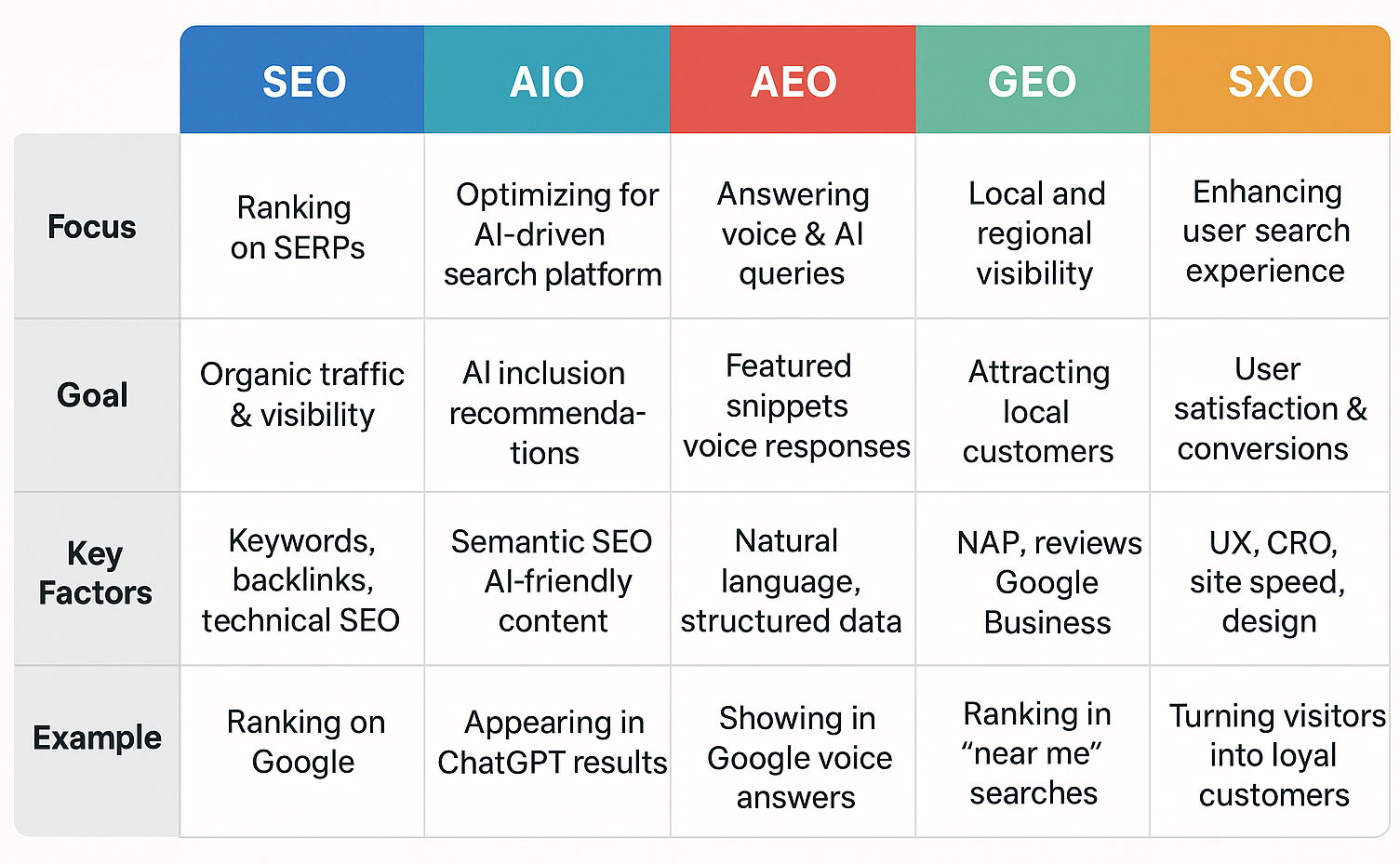
SEO is the process of optimizing your website to rank higher on search engine results pages (SERPs). It involves on-page optimization (content, keywords, meta tags), off-page optimization (backlinks, authority building), and technical SEO (site speed, mobile-friendliness, crawlability).
Focus: Ranking on search engines like Google and Bing
Goal: Increase organic traffic, brand visibility, and conversions
Key Factors: Keywords, content quality, backlinks, technical setup, user signals
Even in 2025, SEO remains the backbone of digital marketing, but to thrive in competitive markets, businesses need to understand the differences in SEO vs AIO vs AEO vs GEO vs SXO and combine these new-age techniques for long-term success.
With the rise of AI tools like ChatGPT, Google Gemini, and Bing Copilot, users are turning to AI-driven platforms for answers instead of traditional search engines. AIO focuses on optimizing your content so that AI models can understand, recommend, and present it effectively.
Focus: Making content AI-friendly for platforms powered by machine learning
Goal: Gain visibility on AI-driven interfaces (chatbots, voice assistants, AI search tools)
Key Factors: Conversational content, structured data, semantic SEO, AI-ready formatting
For example, when a user asks ChatGPT or Google Gemini about “Best Digital Marketing Services in India,” optimized AIO content ensures your brand is included in the AI-generated response.
AEO is closely related to voice search and AI assistants. Instead of typing, users increasingly ask questions verbally through smart devices like Google Assistant, Siri, or Alexa. Answer Engine Optimization ensures your content directly answers user queries in a concise and structured way.
Focus: Optimizing for direct, voice, and conversational queries
Goal: Capture featured snippets, position zero, and voice results
Key Factors: FAQ-style content, natural language, schema markup, concise answers
For instance, if someone asks, “What is the difference between SEO and AEO?”, Google or Alexa should ideally pull a snippet from your website.
GEO, or Geographic Optimization, emphasizes local and regional search visibility. It helps businesses target audiences in specific locations, making it essential for local businesses, service providers, and eCommerce stores with regional audiences.
Focus: Location-based searches and local SEO
Goal: Drive traffic and customers from a defined geographic area
Key Factors: Google Business Profile, local keywords, NAP (Name, Address, Phone), customer reviews, geo-tagging
For example, if you own a digital marketing agency in Kolkata, GEO ensures that when someone searches “Digital Marketing Services in Kolkata”, your business appears at the top of local results.
SXO is the evolution of SEO, where the focus shifts from just ranking to delivering the best search and user experience. It blends SEO, UX (User Experience), and CRO (Conversion Rate Optimization) to ensure users not only find your website but also engage, trust, and convert.
Focus: User experience, engagement, and conversions
Goal: Create seamless journeys from search to conversion
Key Factors: Website speed, responsive design, clear navigation, interactive content, personalized experiences
For example, a website may rank #1 in Google, but if users leave within seconds due to poor design, the ranking won’t translate into business growth. SXO ensures rankings convert into revenue.
Modern digital marketing is no longer about choosing one strategy. Instead, it’s about integrating all five approaches:
SEO provides a foundation for visibility.
AIO ensures your content stays relevant in AI-driven platforms.
AEO helps you capture voice and direct answers.
GEO strengthens local presence and trust.
SXO ensures that traffic converts into customers.
By aligning these strategies, businesses can future-proof their digital presence and dominate online competition.
The comparison of SEO vs AIO vs AEO vs GEO vs SXO highlights how digital marketing continues to evolve with technology and user behavior. While SEO builds the foundation, AIO, AEO, GEO, and SXO add the necessary layers for long-term success. Businesses that adapt these strategies in 2025 will not only rank higher but also deliver meaningful, engaging, and profitable online experiences.
If you’re looking to grow your business digitally, start by combining SEO vs AIO vs AEO vs GEO vs SXO strategies to ensure your brand is visible, relevant, and trusted across all platforms.
1. What is the main difference between SEO and AIO?
SEO focuses on ranking on search engines like Google, while AIO ensures your content is optimized for AI-powered platforms like ChatGPT and Google Gemini.
2. Why is AEO important for voice search?
AEO helps your content appear in direct voice answers and featured snippets, making your brand accessible through smart devices and AI assistants.
3. How does GEO benefit local businesses?
GEO increases visibility in location-based searches, driving more local customers and improving conversions for regional businesses.
4. Is SXO more important than SEO?
SXO doesn’t replace SEO but enhances it. While SEO brings traffic, SXO ensures that visitors have a positive experience and convert into customers.
5. Can all five strategies work together?
Yes. The most effective digital marketing strategies in 2025 integrate SEO, AIO, AEO, GEO, and SXO to maximize visibility, engagement, and ROI.


Email marketing remains one of the most powerful tools in digital marketing. When it will be done in right way, it can drive engagement, build customer loyalty, and significantly boost..
Learn MORE
In the digital age, social media advertising has emerged as one of the most impactful strategies for businesses to connect with their audiences. With billions of users engaging across platforms..
Learn MORE
In today’s digital-first world, every business competes for one crucial metric — visibility. But showing up on search engines is only half the battle. The real victory happens when users..
Learn MORE
In the ever-evolving world of digital marketing, influencer marketing has emerged as one of the most powerful tools for brands to connect with their target audience. As we look ahead..
Learn MORE
The digital marketing landscape is constantly evolving, and one of the most significant advancements in recent years is the integration of Artificial Intelligence (AI) in Search Engine Optimization (SEO). AI..
Learn MORE
Marketing has always been an essential part of any business, helping brands reach their target audience and drive sales. However, with the rise of the internet, marketing strategies have evolved..
Learn MORE
In today’s fast-paced digital landscape, every business needs a strong online presence to stay ahead of the competition. Whether you’re a startup, a local business, or a well-established enterprise, choosing..
Learn MORE
In today’s digital-first world, having a strong online presence is no longer optional, it’s essential. Whether you’re a startup or an established business, your website is often the first point..
Learn MORE
In today’s fast-paced digital landscape, ecommerce web development stands at the core of successful modern retail. Whether you’re a rising entrepreneur or a seasoned business owner, selecting the right platform..
Learn MORE
In the ever-evolving digital world of 2025, having a website is not enough. What matters more is how well it performs. Whether you’re a startup, SME, or large enterprise, an..
Learn MORE
Introduction: The Battle for Visibility Starts Here Imagine having the most beautiful website in your niche—with stunning design, killer content, and world-class products or services. But there’s one problem—no one..
Learn MORE
Imagine this: a person is searching on Google for “best café near me” or “SEO services in India.” Within seconds, Google displays a map with business names, ratings, photos, and..
Learn MORE
In the fast-paced world of digital marketing, businesses must adapt to new technologies, evolving search engines, and changing user behavior. What worked a decade ago in search engine optimization (SEO)..
Learn MORE
When planning to launch an online store, the first challenge is choosing the right platform. Among dozens of options, one question comes up again and again: Is WordPress for eCommerce..
Learn MORE
In today’s digital-first world, visual storytelling is at the heart of brand success. Businesses are no longer competing merely on products or services — they’re competing on perception. And that..
Learn MORE
Introduction: The New Era of Smart Advertising In the fast-evolving world of digital advertising, AI on PPC marketing has emerged as the ultimate game-changer. From automating ad campaigns to predicting..
Learn MORE
In today’s fast-paced digital era, a strong online presence has become the foundation of business success. Whether you run a startup, a mid-sized company, or a large enterprise, digital marketing..
Learn MORE
In today’s fast-moving digital economy, a business’s online presence plays a crucial role in its growth. Whether you run a startup, a local business, or a well-established enterprise, your website..
Learn MORE
In today’s fast-moving digital world, building a brand is no longer just about being online—it’s about being strategically visible at the right place, at the right time, to the right..
Learn MORE
The digital landscape is evolving faster than ever. As we step into 2026, businesses face an online environment shaped by AI-powered search engines, smarter algorithms, and increasingly informed users. Simply..
Learn MORE